Modern Parasitic Draws Are Network Problems in Disguise: A Diagnostic Approach
By Mike Lundgren
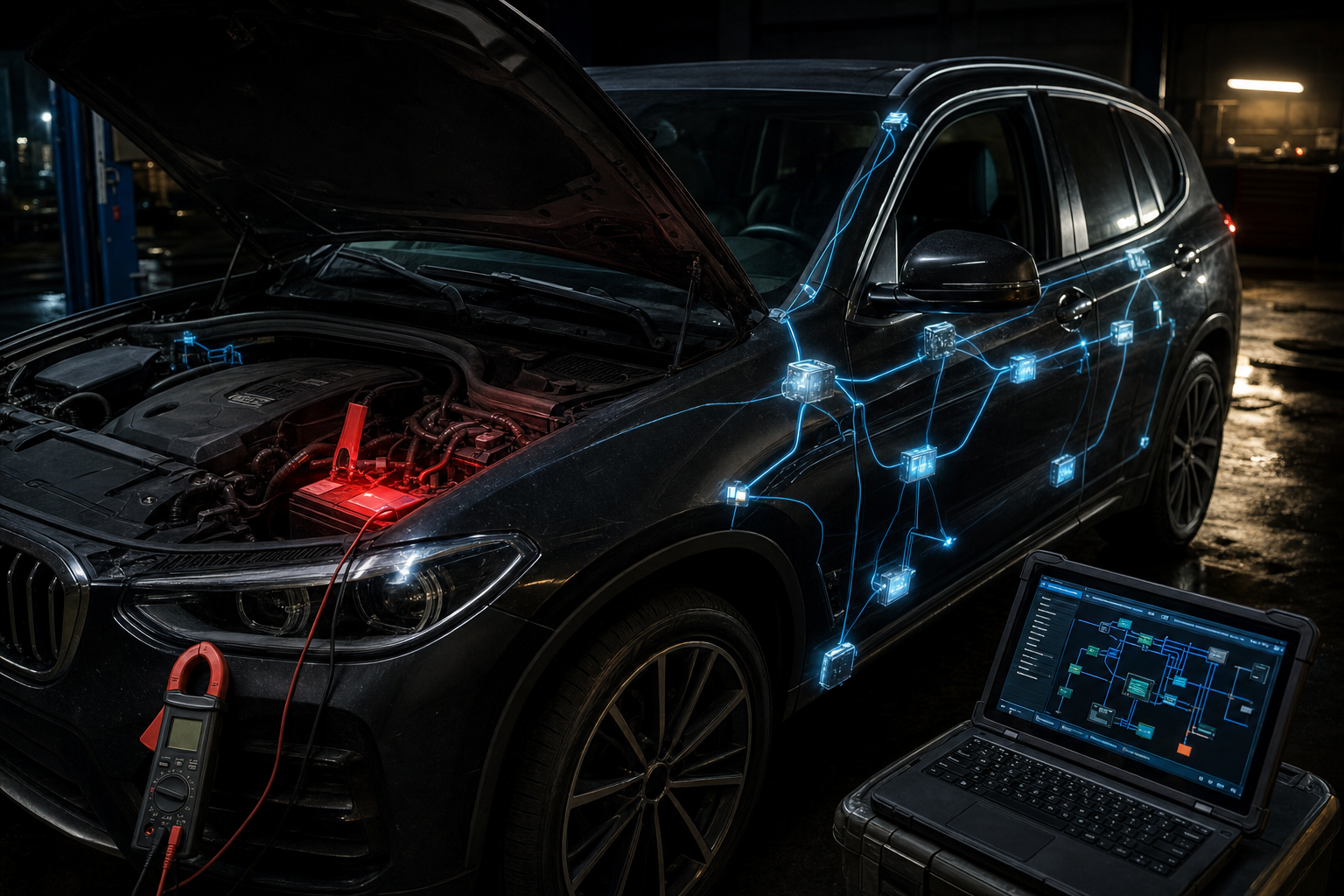
Parasitic draw used to be a fairly straightforward electrical problem. A vehicle sat overnight, the battery went dead, and the diagnostic process often meant measuring current draw and pulling fuses until the drain disappeared.
That approach still has a place, but on modern vehicles it is rarely the whole answer.
Many late-model battery drains are not caused by a simple shorted component. They happen because one or more modules never go to sleep. A door module, radio, body control module, radar sensor, gateway, liftgate latch, telematics unit, or aftermarket device can keep a network awake long after the key is off.
When that happens, the battery drain is not just an electrical draw. It is a network problem.
Why Modern Vehicles Draw Current After Key-Off
Modern vehicles do not shut down instantly when the ignition turns off. Multiple control modules stay awake for a period of time so they can finish tasks, save data, communicate with other modules, and monitor certain inputs.
That normal shutdown process may involve:
- body control modules
- gateway modules
- infotainment systems
- keyless entry modules
- security systems
- ADAS sensors
- telematics modules
- seat, door, liftgate, and lighting modules
- aftermarket alarms, trackers, or remote-start equipment
A vehicle may draw more current for several minutes after shutdown and still be completely normal. The problem begins when the network never settles down.
If one module keeps talking, wakes up repeatedly, or reports an input that never changes state, other modules may stay awake too. The result is a battery drain that looks like a traditional parasitic draw but behaves like a communication fault.
The Fuse-Pulling Trap
Pulling fuses can still identify a circuit, but it can also mislead the diagnosis.
On a networked vehicle, removing a fuse may shut down the module that is causing the draw. It may also shut down a gateway, remove power from part of the network, interrupt a wake-up circuit, or force several modules to reboot.
That can make the draw disappear without proving which module actually caused the problem.
This is why modern parasitic draw testing has to be done carefully. If the test method wakes the vehicle up or changes the network state, the measurement may no longer represent the original failure.
Signs the Draw Is Really a Network Problem
A network-related battery drain often leaves clues before any advanced testing begins.
Common signs include:
- illuminated switch backlighting after the vehicle should be asleep
- radio, cluster, or infotainment activity after key-off
- repeated relay clicks
- scan tool communication with modules that should be asleep
- current draw that pulses in a repeating pattern
- intermittent dead battery complaints with no obvious short
- communication codes stored across multiple modules
- a draw that disappears temporarily after disconnecting the battery
A pulsing draw is especially suspicious. If current rises and falls on a regular interval, a module may be waking the network, timing out, and then waking it again.
Start With the Complaint and the Sleep Strategy
The first step is not to pull fuses. The first step is understanding the complaint.
Important questions include:
- How long does the vehicle sit before the battery dies?
- Does it happen every night or only occasionally?
- Was any work recently performed?
- Are there aftermarket accessories installed?
- Does the problem happen after locking the vehicle, leaving it unlocked, or using remote start?
- Are any lights, screens, or fans staying on?
- Are there water leaks, collision repairs, or rodent damage concerns?
Then the vehicle has to be allowed to enter its normal sleep process. That may require closing latches, disabling hood switches correctly, keeping keys away from the vehicle, and waiting long enough for the network to time out.
Testing too early can turn a normal shutdown period into a false parasitic draw diagnosis.
Measure the Draw Without Waking the Vehicle
A proper parasitic draw test should measure current while disturbing the vehicle as little as possible.
Depending on the vehicle and tools available, that may involve:
- an amp clamp around the battery cable
- an inline ammeter with a protected bypass setup
- voltage-drop testing across fuses
- scan data that shows module sleep status
- service information for expected shutdown behavior
- wiring diagrams to understand network and power distribution
The goal is to answer two questions:
- How much current is the vehicle drawing after it should be asleep?
- Which module, circuit, or network activity is preventing normal sleep?
Those are not always the same question.
Look for the Module Keeping the Network Awake
Once excessive draw is confirmed, the next step is to identify what is staying awake and why.
That may require checking:
- which modules still communicate after shutdown
- whether a gateway reports active network traffic
- whether a door, hood, liftgate, or seat switch is reporting the wrong state
- whether an infotainment or telematics module keeps cycling
- whether an ADAS module is waking the bus
- whether water intrusion is affecting connectors or modules
- whether aftermarket equipment is tied into constant power or network wiring
Sometimes the failed part is not the module with the highest current draw. It may be a small input or sensor that keeps a larger system awake.
For example, a latch switch that never reports closed may keep a body network alive. A radar module with an internal fault may repeatedly wake a gateway. A radio module may keep cycling and prevent a relay from shutting down. A network short or corrosion issue may keep modules from completing their sleep sequence.
Why Scan Tools Matter in Parasitic Draw Diagnosis
A scan tool is not always the first tool used in parasitic draw testing, but on modern vehicles it can be one of the most important.
Scan data may show:
- module communication status
- wake-up inputs
- power mode state
- retained accessory power status
- door and latch states
- network communication faults
- history codes that point toward the module waking the bus
The caution is that connecting a scan tool can also wake the vehicle. The information is useful, but it has to be gathered with an understanding of how the vehicle behaves when diagnostic equipment is connected.
The Right Fix Depends on the Root Cause
A modern parasitic draw can be caused by many different failures:
- a module that will not enter sleep mode
- a sensor or switch reporting the wrong state
- water intrusion in a connector or module
- damaged network wiring
- an aftermarket accessory wired incorrectly
- software that needs an update
- a gateway being kept awake by another module
- a relay or power distribution issue
Replacing the battery may temporarily hide the symptom, but it will not fix the draw. Replacing the module with the largest current draw may also miss the real cause if that module is only awake because another input is commanding it to stay awake.
The repair has to match the reason the network stayed awake.
When to Call for Help
Parasitic draw diagnosis can consume hours quickly, especially when the problem is intermittent or network-related. The most expensive path is guessing at modules without proving what is keeping the vehicle awake.
A specialist diagnostic approach helps when:
- the battery has already been replaced
- the draw comes and goes
- multiple modules show communication codes
- the vehicle wakes up repeatedly after key-off
- an aftermarket accessory may be involved
- a shop has already pulled fuses without a clear answer
- the vehicle needs network testing, scan data, or wiring analysis
ST Mobile Auto provides mobile electrical diagnostics, module programming, and advanced network troubleshooting for repair shops and vehicle owners in the Twin Cities area.
If a modern vehicle keeps killing the battery, the question is not just “what circuit draws current?” The better question is: “why is the vehicle still awake?”
That is where the diagnosis usually starts to make sense.
Need Help With This?
We handle jobs like these every day for shops across the Twin Cities.