Why Your Car Won't Start in Cold Weather: Two Diagnostic Case Studies
By Mike Lundgren
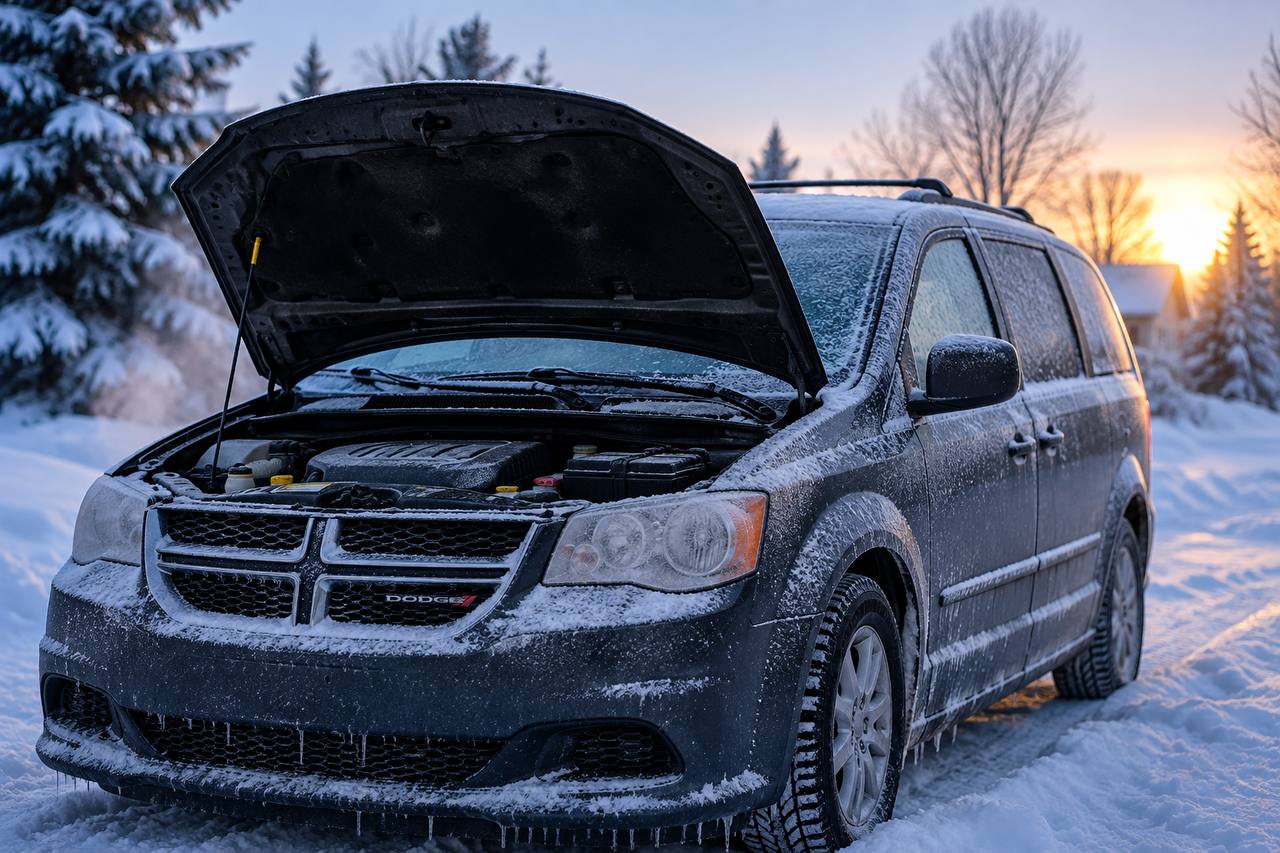
When a vehicle will not start on a freezing morning, the first suspicion is usually the battery. Sometimes that is correct. Cold weather reduces battery output, thickens engine oil, and exposes weak electrical connections that were barely working in warmer temperatures.
But not every cold-weather no-start is a simple battery problem.
Some failures only show up when temperature, moisture, wiring resistance, and module behavior all line up the wrong way. Those are the cases where guessing gets expensive. The right answer comes from testing the system while the problem is actually happening.
Here are two real-world diagnostic case studies that show why cold-weather starting problems deserve more than a quick battery swap.
Case Study 1: The Vehicle That Would Not Crank in the Cold
In this case, the complaint sounded straightforward: the vehicle would intermittently refuse to crank when the temperature dropped.
That type of symptom can point in several directions:
- weak battery output
- poor battery cable connections
- starter relay problems
- starter motor failure
- ignition switch or start-request issues
- neutral safety / range switch input problems
- powertrain control module logic refusing to command the starter
The key is not to start replacing parts from that list. The key is to find out which part of the starting system is missing when the no-start occurs.
A proper diagnostic path asks questions like:
- Is the battery voltage dropping too low under load?
- Is the starter relay being commanded?
- Is the control module seeing a valid start request?
- Are the necessary park/neutral or security inputs present?
- Is power making it to the starter solenoid when the failure happens?
Cold weather can make marginal circuits fail because resistance changes, connectors contract, and weak relays or modules behave differently. If the vehicle starts normally later in the day, that does not mean the problem disappeared. It means the test window closed.
Case Study 2: The Vehicle That Had Power But Still Would Not Start
Another cold-weather case looked like an electrical power issue at first. The vehicle had symptoms that could have been blamed on a weak battery or poor connection, but testing showed the problem was deeper than that.
Modern vehicles do not simply send power from the key to the starter. Several modules may be involved before the starter is allowed to engage or the engine is allowed to run. A no-start can be caused by a missing input, a module communication issue, a relay control problem, or a circuit that only fails under certain conditions.
That is why scan data, wiring diagrams, and voltage testing matter.
A technician may need to confirm:
- whether the engine computer is awake and communicating
- whether immobilizer or security authorization is present
- whether the starter relay is being controlled
- whether relay power and ground are available
- whether the module has the inputs it needs before it will command output
- whether the failure changes when the vehicle warms up
In cold-weather diagnostics, the symptom often matters less than the missing piece of the control chain. A vehicle can have a good battery and still refuse to start if one required signal is missing.
Why Cold Weather Makes Diagnosis Harder
Cold weather does not just create new problems. It reveals weak spots that may have been present for months.
Common examples include:
- battery cables with hidden voltage drop
- corroded connectors that change resistance with temperature
- relays that work intermittently
- modules that fail when cold-soaked
- wiring damage that only shows up under load
- moisture intrusion that freezes or changes circuit behavior
- weak batteries that pass a basic voltage check but fail under real load
That last point is important: a battery showing 12 volts at rest is not proof that it can crank the engine. Testing must be done under load, and the rest of the starting system still needs to be verified.
The Difference Between Guessing and Diagnosing
A cold-weather no-start can easily turn into a parts cannon situation:
- replace the battery
- replace the starter
- replace a relay
- replace another battery
- hope the vehicle starts next time it gets cold
That approach is expensive and unreliable.
A diagnostic approach is different:
- reproduce or catch the symptom
- identify which system is not doing its job
- test the circuit or module at the moment of failure
- prove what is missing
- replace or repair only the part that failed
That process protects the customer from unnecessary parts and gives the repair shop a much better chance of fixing the problem the first time.
When to Call for Diagnostic Help
If a vehicle will not start in cold weather and a jump-start does not clearly solve the issue, it is time to test instead of guess.
Professional diagnostics are especially important when:
- the battery has already been replaced
- the starter has already been replaced
- the no-start only happens below a certain temperature
- the vehicle starts later without repair
- the dash lights up but the engine does not crank
- multiple warning lights or communication codes are present
- a shop has already tried the obvious parts
ST Mobile Auto specializes in electrical diagnostics, module programming, and advanced no-start problems for repair shops and vehicle owners in the Twin Cities area.
If your vehicle will not start in cold weather and the usual fixes are not solving it, the next step is not another guess. The next step is finding out what the vehicle is missing when it fails.
Need Help With This?
We handle jobs like these every day for shops across the Twin Cities.