Mouse Damage HVAC: 2019 Corolla Case
By Mike Lundgren
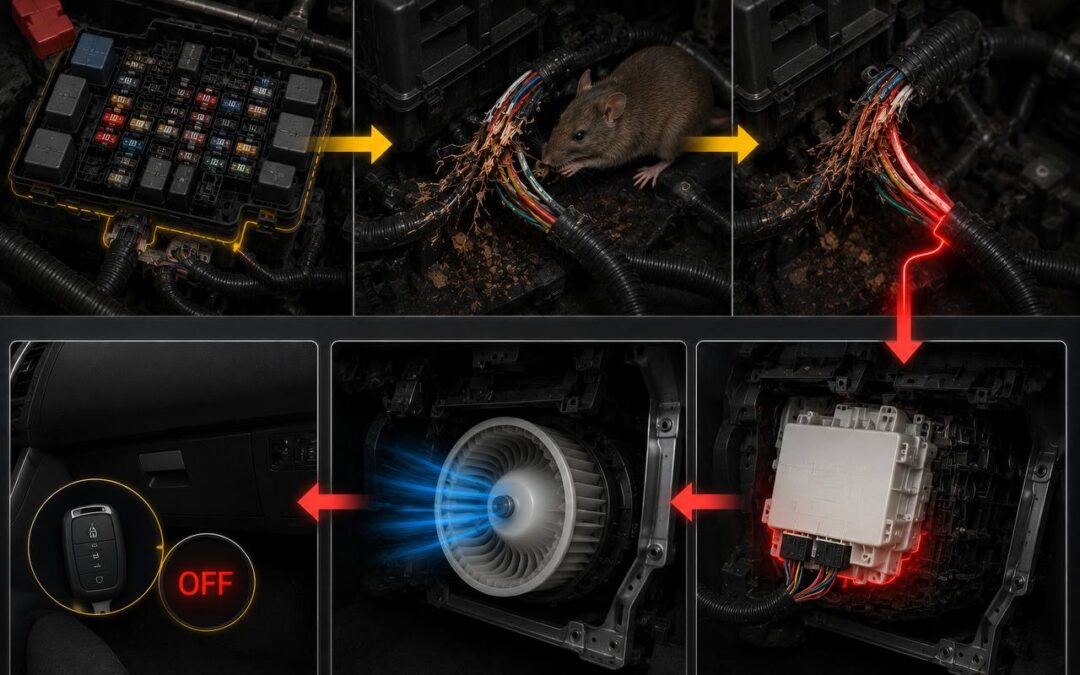
When a 2019 Toyota Corolla’s HVAC system stays powered on after the key is removed, the problem isn’t always a faulty control module. In this case, mouse damage created both an open circuit and a short to power in the same wire, causing the AC amplifier to remain active and drain the battery. This unique electrical fault demonstrates why rodent damage requires careful diagnostic work rather than parts replacement.
The Problem: HVAC System Won’t Turn Off
The Toyota Corolla came to the shop with a specific complaint: after driving and shutting off the vehicle, the HVAC controls in the center dash would remain active indefinitely. The customer could remove the key, but the climate control system continued running until the battery died. The system remained fully functional during this time — you could adjust temperature, fan speed, and all other HVAC functions as if the ignition was still on.
The shop had already replaced the AC amplifier (the main HVAC control module) with a used unit, but the problem persisted. When they unplugged the AC amplifier, the HVAC screen would turn off and the battery drain stopped, which initially pointed to the module as the culprit.
Diagnostic Process: Following the Power
The AC amplifier receives power through three main circuits: constant battery power, ground, and a switched ignition feed via a blue wire. When the key is off, that switched ignition feed should have no power. However, testing revealed 12 volts present on this blue wire even with the key removed.
The blue wire connects to a heater ignition fuse in the under-dash fuse box, which also had power when it shouldn’t. This 10-amp fuse feeds four different components: the dash control assembly, AC amplifier, compressor relay, and other under-hood relays.
To determine if power was being fed to the fuse or backfeeding from one of the components, the fuse was removed with the key off. The HVAC system remained active, and power was still present on the component side of the fuse — indicating a short to power somewhere in the circuit.
The Key Discovery: Multiple Circuit Damage
Further testing revealed that unplugging the AC amplifier eliminated power on the blue ignition wire. This meant power was backfeeding through the module from another source. Checking all pins on the AC amplifier connector with a test light revealed unexpected power on pin 2 — a light green wire that should only carry power when the AC amplifier energizes the compressor solenoid.
However, the compressor was already unplugged, and testing at the compressor showed no power on the light green wire. This indicated both an open circuit (no power reaching the compressor) and a short to power (12 volts present at the AC amplifier) on the same wire.
Two connectors exist between the AC amplifier and compressor: AE6 under the passenger dash and BA2 in the under-hood fuse box. Testing at AE6 showed power on the side going toward the engine bay. Testing at BA2 showed no power on either side, narrowing the problem to the harness section between these connectors.
Finding the Mouse Damage
Evidence of rodent activity was visible under the hood — chewed firewall padding and nesting material under the intake. When the under-hood fuse box was lifted, the damage became clear: a mouse had chewed through the light green compressor control wire along with an adjacent constant power wire.
The chewing created two simultaneous faults:
- An open circuit toward the compressor (explaining why no power reached the compressor)
- A short between the light green wire and a constant power wire (explaining the backfeed through the AC amplifier)
This constant power backfed through the AC amplifier onto the blue ignition circuit, keeping the HVAC system active even with the key off.
What This Means for Your Shop
This case illustrates why rodent damage creates unique diagnostic challenges. Unlike pattern failures that affect multiple vehicles the same way, mouse damage typically creates one-off problems specific to where and how the wires were chewed.
Key diagnostic principles for similar situations:
- When unplugging a module solves the problem, don’t automatically assume the module is faulty
- Check all power feeds to the module — you should only find power where the wiring diagram shows it should be
- Unexpected power on a circuit often indicates a short from another wire
- Rodent damage frequently occurs in protected areas like under fuse boxes, behind panels, or in contained spaces
The same diagnostic approach applies to other electrical faults. A module that appears to be dragging down a CAN bus network might actually have a ground problem rather than internal failure. Always verify the basics before replacing components.
Professional Electrical Diagnostics in the Twin Cities
Complex electrical problems like this rodent damage case require systematic diagnostic skills and proper equipment. ST Mobile Auto provides on-site electrical diagnostics throughout the Minneapolis and St. Paul metro area, bringing professional-grade tools and expertise directly to your shop.
Whether you’re dealing with mysterious power drains, communication issues, or unusual electrical symptoms, our mobile diagnostic service can help identify the root cause and provide repair guidance. We work with shops throughout the Twin Cities to solve challenging electrical problems efficiently.
Contact ST Mobile Auto at
Need Help With This?
We handle jobs like these every day for shops across the Twin Cities.