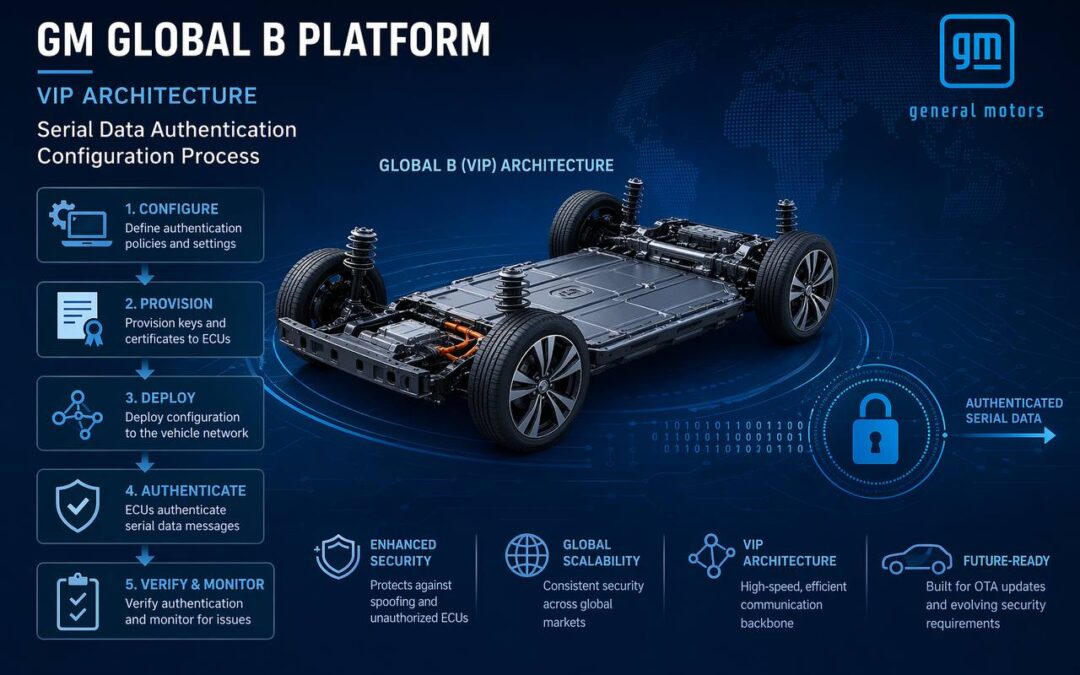
GM’s Global B VIP (Vehicle Intelligence Program) architecture, found on 2020+ General Motors vehicles, introduces a complex security authentication system that can create unexpected challenges when programming modules. Unlike the simpler pin-sharing system in Global A vehicles, Global B uses cryptographic security checks that can force replacement of modules that were previously working fine.
What is GM Global B VIP Architecture?
Global B VIP architecture represents GM’s advanced vehicle platform featuring:
- CAN FD (Flexible Data Rate) networks for faster data transfer
- Over-the-air update capability
- Multiple CAN bus networks (often 7-8 separate networks)
- Serial Data Gateway Module as the central communication hub
- Ethernet switches in gateway and radio modules
This architecture debuted on 2021 GMC Yukon and Chevrolet Tahoe SUVs, with pickup trucks following in later model years. The system requires specific diagnostic equipment and procedures that differ significantly from previous GM platforms.
Programming Requirements for Global B Vehicles
Programming Global B modules requires:
- MDI-2 interface: The older MDI-1 will not work, and while KARDAC-3 is approved, MDI-2 is recommended
- Key-off programming: Unlike most vehicles, Global B programming occurs with the ignition off
- Ethernet connection: Some modules like front cameras require ethernet cable connection to the MDI-2
- CAN FD compatible scan tools: Standard tools may not communicate properly
The SDAC Process
After completing standard module programming through TLC, Global B vehicles require Serial Data Authentication Configuration (SDAC). This process involves:
- Cryptographic security handshake between all modules
- Verification through GM’s SPS server
- SHA-256 encryption and Diffie-Hellman exchange protocols
- Authentication of every module on the vehicle network
The SDAC Failure Problem
GM acknowledges in their technical service bulletins that SDAC failures are common. When SDAC fails, it identifies a specific module (by alphanumeric code like P16 for instrument cluster or K73 for telematics) that cannot authenticate properly.
Critical point: The failing module may not be the one you replaced. It could be any module on the vehicle that was previously working fine but cannot pass the new security authentication.
Common Modules That Fail SDAC
- Telematics module (K73)
- Instrument cluster (P16)
- Airbag module
SDAC Failure Resolution Process
When SDAC fails for a specific module:
- Check the failing module for software updates
- Attempt SDAC again (system tries three times automatically)
- If still failing, disconnect the module from the network
- Jump network connections to maintain continuity
- Retry SDAC with module disconnected
- If SDAC passes, the disconnected module must be replaced
Real-World Case Study: 2021 GMC Yukon
A recent case involving a 2021 GMC Yukon Denali illustrates these challenges. The shop replaced a Serial Data Gateway Module due to damaged connector pins, but during SDAC, the instrument cluster (P16) failed authentication. The cluster had no codes and was functioning normally, but could not pass the security handshake.
Following GM’s procedure required:
- Partial dashboard disassembly to access cluster connector
- Jumping network pins to maintain CAN bus continuity
- Running SDAC with cluster disconnected (which passed)
- Replacing the otherwise functional instrument cluster
What This Means for Your Shop
Global B architecture programming carries significant financial risk. When programming any module on these vehicles, you may need to replace additional modules that were previously working. This isn’t a diagnostic failure—it’s how the security system works.
Customer communication is critical. Before beginning any Global B module programming, inform customers that:
- Additional modules may require replacement during the security authentication process
- These modules may be functioning normally but fail GM’s security handshake
- There’s no way to predict which modules might fail SDAC
- The process is required by GM and cannot be bypassed
Network Diagnostic Advantages
Global B does offer improved diagnostic capabilities through GDS2’s advanced network functions, allowing technicians to:
- Break down problems by individual networks
- View error events and communication failures
- Identify specific CAN bus issues more efficiently
Get Expert Help with Global B Programming
Global B VIP architecture represents a significant shift in GM’s approach to vehicle security and module programming. The complexity of SDAC and potential for unexpected module replacements requires careful planning and customer communication.
ST Mobile Auto provides on-site Global B module programming services throughout the Twin Cities metro area. Our team understands the intricacies of SDAC authentication and can help navigate these complex procedures while minimizing surprises for your shop and customers.
For Global B programming support or questions about SDAC procedures, contact ST Mobile Auto at (612) 355-9566 or submit a service request at https://stmobileauto.com/shop-forms/.